.png)
Launching a new product is challenging. Entering an entirely new customer category is a completely different ballgame.
When DUDE Wipes launched Lil’ DUDE Wipes, the team quickly realized they couldn't rely on the same creator strategy that worked for the core brand.
Instead, they built the campaign around a specific moment in parents' lives when new habits were already forming.
This is the playbook they used to make that transition work.
Why entering a new category changes your creator strategy
Most creator strategies are built around a specific audience.
Over time, brands learn which creators resonate, which messages convert, and which content formats consistently drive results. But when you enter a new category, many of those proven strategies no longer work.
That was the challenge faced with Lil’ DUDE Wipes.
For years, the brand had built its audience around comedy, sports, internet culture, and “dude humor.” Parenting content operates very differently.
Parents aren’t looking for entertainment alone. They are looking for practical solutions, trusted recommendations, and products that fit naturally into routines that already feel stressful, messy, or overwhelming.
That changes how their creator marketing strategy needs to work.
You can’t rely on the same creator profiles, messaging angles, or content formats that worked for your existing audience. When you enter a new category, the entire buying context changes: why people buy, when they buy, who they trust, and what type of content influences their decisions.
For Lil’ DUDE Wipes, the challenge was not simply finding parenting creators. It was understanding a specific moment in a parent's journey and building a creator strategy around it.
The team needed to answer questions like:
- When are parents most open to trying a new hygiene product?
- Which affiliate creators are already documenting that stage of life?
- How can the product feel genuinely useful instead of promotional?
- How can it be integrated into content naturally rather than inserted into it?
Those questions led to a very different approach.
Instead of treating the launch like a traditional influencer campaign, DUDE Wipes built the strategy around a real behavior shift already happening in parents' lives.
That insight became the foundation for everything that followed.
Find the lifequake that creates demand
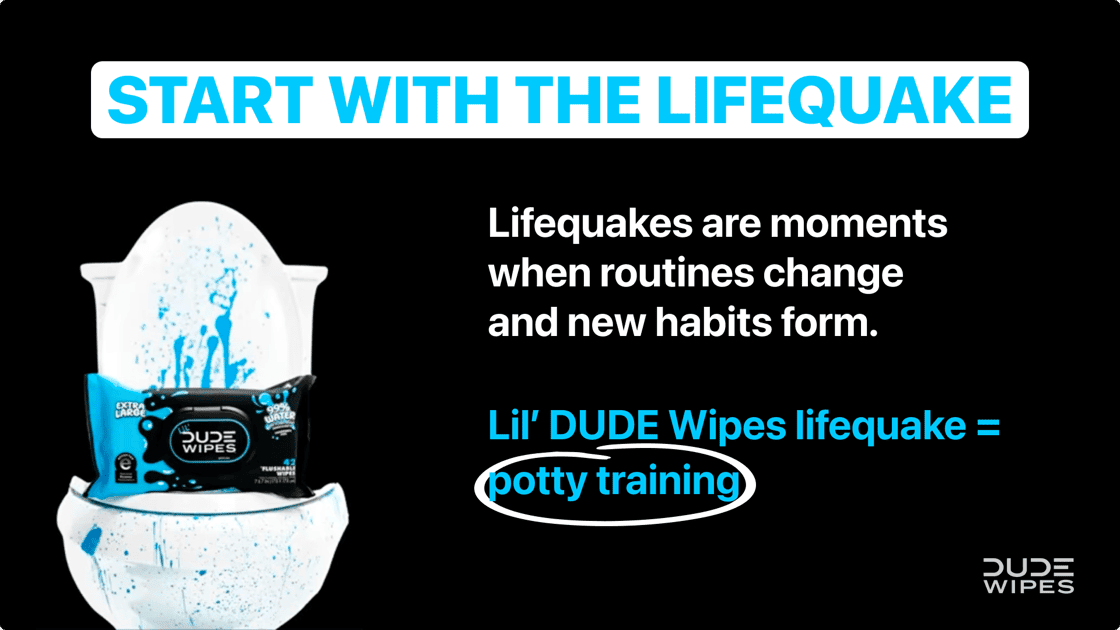
One framework the DUDE Wipes team relies on is identifying “lifequakes.”
A lifequake is a major life transition where routines suddenly change and new habits start forming. It could be starting college, getting married, becoming a parent, or going through puberty.
"Lifequakes are moments when people's routines suddenly change and new habits are formed. These are moments when people are actively building new routines, and they're much more open to discovering new products."
— Kayla Marcum, Influencer Marketing @ DUDE Wipes
These moments are valuable because people are already searching for new routines, products, and recommendations that fit into this new phase of life.
Instead of trying to change an established habit, brands can become part of a habit that's still being formed.
Why potty training became the entry point
For Lil’ DUDE Wipes, the lifequake was obvious: potty training.
Potty training is one of the biggest hygiene transitions in early childhood. Parents are suddenly trying to figure out what belongs in the bathroom, how to teach healthy habits, and which products make the process easier.
That made it the perfect entry point for the product.
Rather than convincing parents to change an existing behavior, DUDE Wipes had an opportunity to become part of a new routine from the beginning.
Just as importantly, potty training was already a topic parenting creators were discussing with their audiences. Bathroom challenges, toddler milestones, parenting frustrations, and household routines were already showing up in their content.
That meant Lil' DUDE Wipes didn't need a manufactured reason to be part of the conversation. The product naturally fit into a moment parents were already navigating and creators were already documenting.
Once the team identified that moment, they could start building the campaign around it.
Build your campaign goals around the behavior shift
Once DUDE Wipes identified potty training as the key lifequake, the next step was turning that insight into a campaign strategy.
Rather than launching Lil' DUDE Wipes to parents broadly, the team built the campaign around the specific needs, questions, and habits that emerge during the potty-training journey.
That focus helped shape every decision that followed. From creator selection and messaging to retail alignment and product seeding, each objective was designed to make Lil' DUDE Wipes feel like a natural part of a routine parents were already building.
The team focused on four goals.
1. Educate parents on the product
Parents already know baby wipes exist. But once kids move out of diapers, wipes usually disappear from the conversation entirely.
So the first challenge was behavioral education. The team needed creators to help parents rethink bathroom hygiene during potty training and introduce wipes as a practical part of that routine.
"Baby wipes obviously exist, but once kids get out of diapers, wipes just kind of disappear from the conversation somewhat. Our goal was to introduce the wipes as a cleaner, easier solution for kids learning bathroom hygiene."
— Kayla Marcum, Influencer Marketing @ DUDE Wipes
The team needed creators to help parents associate wipes with potty-training routines and early bathroom hygiene habits.
2. Build credibility with a completely new audience
DUDE Wipes already had strong brand recognition, but mostly within its existing audience. Parents rely heavily on trusted recommendations, especially when they're navigating decisions for their children.
The brand needed creators who could help make Lil’ DUDE Wipes feel approachable, useful, and genuinely family-oriented without losing the personality the brand was already known for.
"This was our opportunity to start building credibility with parents and families and create something fun for kids. It was really cool to see that we were creating something special that kids were genuinely excited about."
— Kayla Marcum, Influencer Marketing @ DUDE Wipes
That’s a difficult balance when you’re entering a category where trust matters more than entertainment.
3. Align the campaign with how parents shop
Lil' DUDE Wipes launched exclusively at Walmart, which meant the creator strategy couldn't be separated from the buying experience.
The goal wasn't just to make parents aware of the product. It was to make discovery feel natural by showing the product in the same places and contexts where families already shop.
That meant partnering with creators whose content reflected real shopping behaviors and everyday family routines. Retail distribution wasn't just a logistics decision. It became a key input into who the brand partnered with and how the product showed up in content.
4. Build early social proof through creator seeding
Before scaling paid partnerships, the team wanted parents to start seeing the product naturally appear across creator content. So they focused heavily on gifting and product seeding early on.
That helped generate organic posts, reactions, and conversations inside parenting communities before pushing harder on larger campaign activations.
And because many creators already knew the DUDE Wipes brand, the excitement around a kid-focused version of the product felt genuine rather than manufactured.
How DUDE Wipes turned the strategy into creator partnerships
With the objectives established, the focus shifted to execution.
The team needed to answer three practical questions:
- How do we find creators living through the right life stage?
- How do we choose creators who feel authentic to the product?
- How do we integrate the product into content naturally?
The answers shaped the entire creator strategy.
Use social listening to find creators at the right moment
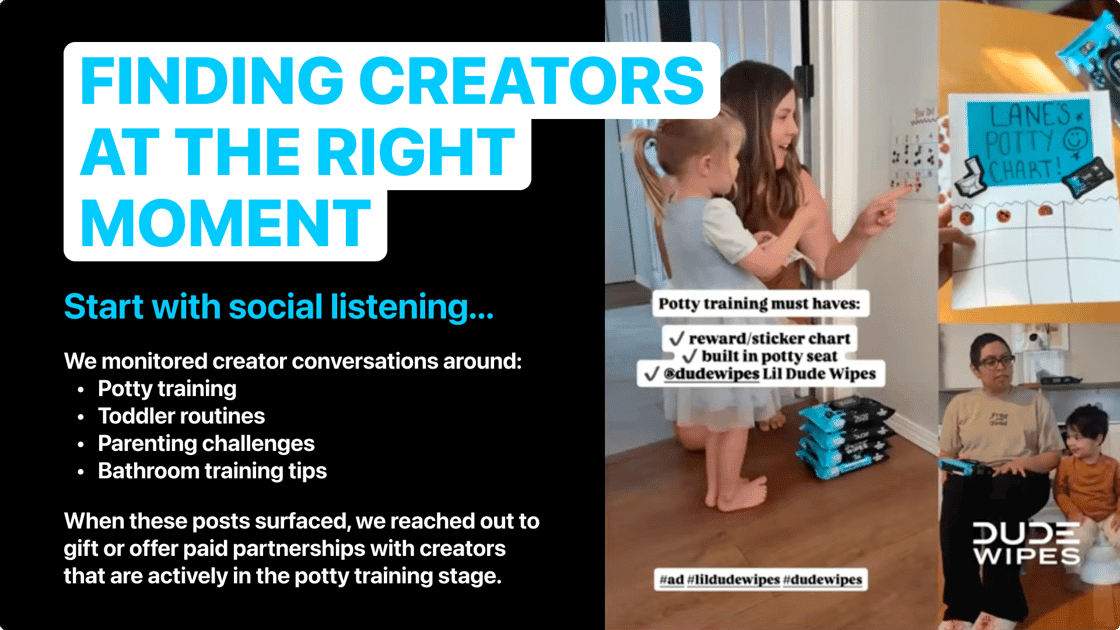
Once the team identified potty training as the key lifequake, creator discovery became much more intentional. The goal shifted from building a massive list of parenting influencers to finding creators who were actively going through that stage of life with their audience in real time.
That’s where social listening became a critical part of the strategy.
The DUDE Wipes team monitored creators talking about toddler milestones, bathroom routines, parenting struggles, and day-to-day family life.
"When those posts surface on our social listening streams, that's our signal that that creator is actively in the potty training stage, or about to be, and their audience is along for the journey with them."
— Kayla Marcum, Influencer Marketing @ DUDE Wipes
Those conversations told the team exactly when a creator had entered the potty-training stage.
If a creator was already documenting potty training frustrations or sharing that transition with their audience, the product immediately felt relevant within that conversation.
Instead of introducing a product out of context, the team was able to join a discussion that was already happening.
This is also where social listening becomes valuable for brands running affiliate and influencer programs at scale.
Social Snowball's social listening feature, for example, helps brands track mentions, tagged posts, and emerging creator conversations in real time, making it easier to identify creators who are already talking about relevant topics.
Choose creators whose content reflects how customers shop
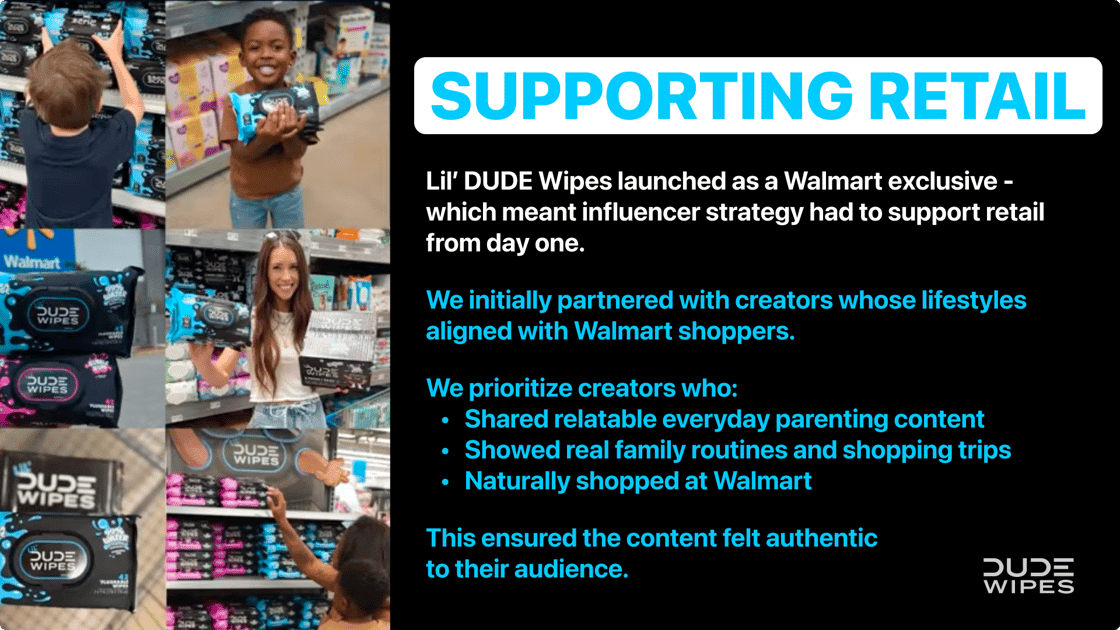
Lil’ DUDE Wipes launched as a Walmart exclusive, which directly influenced how the team approached creator partnerships.
They prioritized creators whose content already reflected everyday family shopping habits:
- Walmart runs
- Grocery trips
- Household restocks
- Budget-conscious family routines
That retail alignment mattered because audiences pay attention to shopping behavior.
"For this specific campaign and where it was available, it just wouldn't look natural for those luxury, high-end creators to walk into a Walmart if that wasn't already part of their routine and their content. Audiences can feel that disconnect immediately."
— Kayla Marcum, Influencer Marketing @ DUDE Wipes
If a creator typically shops at luxury retailers, suddenly featuring a Walmart-exclusive product can feel disconnected from the rest of their content.
The strongest partnerships came from creators whose audience could realistically picture themselves finding the product during their normal shopping routine.
For DUDE Wipes, retail distribution wasn't just a logistics consideration. It became a creator-selection filter.
Make the product part of existing content formats
Lil’ DUDE Wipes consistently appeared within content formats that parenting creators were already publishing every week. That format choice was important because wipes are a routine-driven household product.
Parents don’t usually discover products like this through a single dedicated explainer video. They discover them through repeated exposure across everyday content, like:
- A bathroom restock video
- A Walmart haul
- A parenting update
- A quick routine clip.
"It doesn't have to be a dedicated retail post. Creators can naturally integrate the products into shopping hauls, restocks, and routines. Especially with our product specifically, you can only talk so much about wipes."
— Kayla Marcum, Influencer Marketing @ DUDE Wipes
Instead of building content around the product, the team made the product fit naturally into content that already existed.
That approach helped Lil' DUDE Wipes appear as part of everyday family life rather than as a standalone promotion. The product kept showing up across recurring creator series, shopping content, and parenting updates, creating repeated exposure without feeling repetitive.
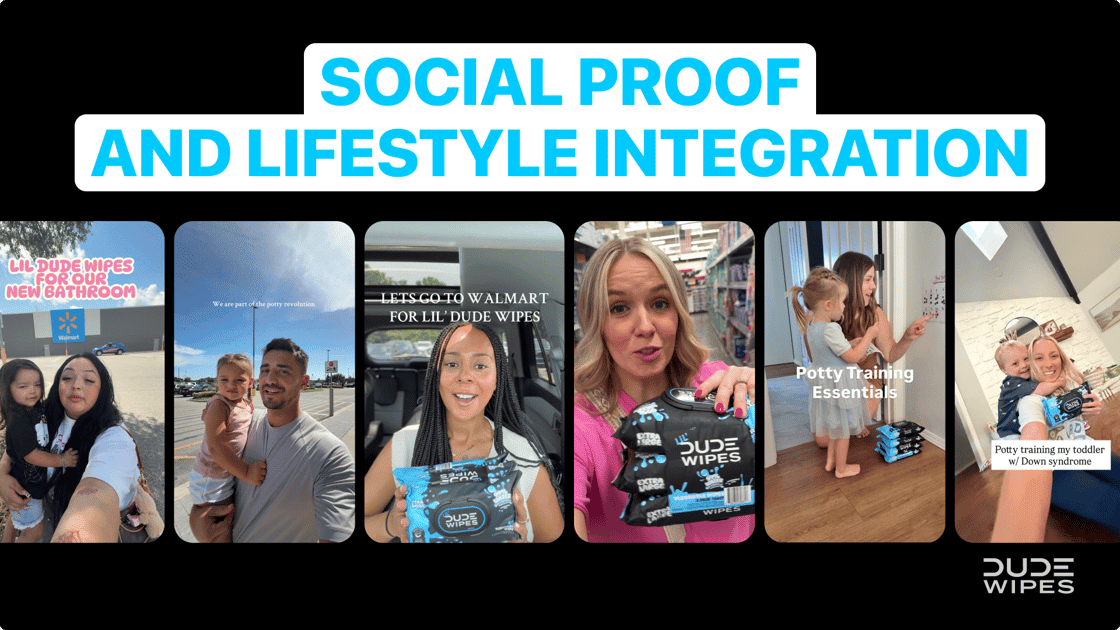
The DUDE Wipes playbook for entering a new category
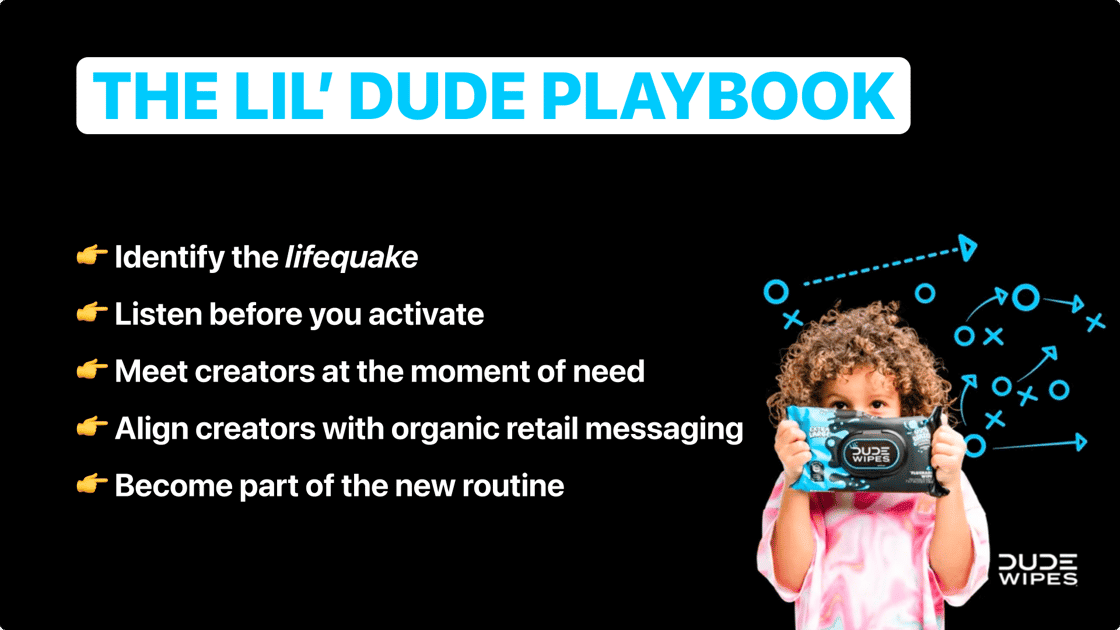
If you’re entering a new category through creator marketing, the DUDE Wipes playbook comes down to a few key execution decisions:
- Identify moments when consumers are already changing behaviors and building new habits
- Build your campaign around a specific life stage instead of a broad demographic
- Use social listening to find creators actively experiencing that moment with their audience
- Align creator selection with how and where customers actually shop
- Integrate products into content formats that creators already publish regularly
- Use gifting and product seeding to generate early social proof
- Make products feel like a natural part of existing routines rather than a standalone promotion
The biggest takeaway from the launch is that successful category expansion starts with understanding consumer behavior.
The creator selection, retail alignment, content formats, and timing all worked together because they reflected how parents were already shopping, sharing, and talking online.
Ready to build creator campaigns around real consumer behavior?
The strongest creator campaigns don’t start with influencer lists or content briefs. They start with understanding when people are most open to discovering something new and identifying the creators who already have credibility in those moments.
Social Snowball helps brands operationalize that strategy at scale.
With tools for social listening, creator discovery, UGC tracking, gifting campaigns, affiliate management, and performance tracking, brands can identify emerging creator opportunities earlier and turn authentic creator relationships into a repeatable growth channel.
Whether you're launching a new product, entering a new category, or scaling an existing creator program, Social Snowball gives your team the infrastructure to manage it all in one place.
.png)

.avif)