
Most creator teams spend hours manually searching for creators, reviewing profiles, and deciding who to contact. Warmies, famous for their microwave-safe weighted plush toys, took a different approach.
At the Influencer Marketing Summit: Summer '26, VP of Consumer at Warmies, Christian Cook, shared how his team rebuilt their creator sourcing process using an AI-powered scoring algorithm.
Instead of relying on agencies, expanding the team, or spending hours searching for creators, they automated creator discovery, qualification, and recruiting, reducing their cost per qualified lead from around $12 to $0.13.
In this article, we'll break down how their system works, why they built it, and the lessons your brand can apply to make creator sourcing fast, efficient, and scalable.
The problem with manual creator discovery
Creator partnerships are one of Warmies' highest-ROI acquisition channels. To keep the program growing, they have to continuously fill their pipeline with qualified creators.
Initially, Christian outsourced the process to creator sourcing agencies. Every week, they’d deliver 100 to 200 creator leads for his team to review.
The process was entirely manual:
- The agency sent a list of creator recommendations.
- The Warmies team reviewed each profile one-by-one.
- They shortlisted creators that matched their criteria.
- They sent cold DMs to the best-fit creators.
- They negotiated rates and product sampling.
- They tracked posts, engagement, and GMV in spreadsheets.

The issue was the amount of time required to qualify every creator on those lists. Every additional recommendation added another profile to review before outreach could even begin.
"The biggest question was: how do we scale this?"
He also realized that recommendations from agencies made it harder for the team to identify standout creators capable of delivering outsized results.
"My belief is that when we were working with agencies, those 100 to 200 creator leads that we got a week were typically mid-tier, safe options."
The process was slow, expensive, and hard to scale. Instead of relying on manually curated lists, Christian and his team built their own qualification system.
Rethinking creator discovery with a scoring rubric
Before we talk about the creator scoring engine that Warmies built, let’s understand what a creator scoring rubric is.
A creator scoring rubric is a framework for evaluating how well a creator matches your brand. It scores creators against a set of predefined criteria that reflect what success looks like for your business.
As Christian explains:
"Take a look at the creators that you are working with today and the best creators and work out what good looks like. Put together a heavy scoring criteria... then use your scoring criteria as your gate. So be as specific as possible."
Every brand’s rubric is different. Since each brand has different products, audiences, and goals, the creators who perform well for one brand won’t be the right fit for another.
"It has to be personalized to the brand because what's important to Warmies... might not be important to a different brand."
How Warmies built an AI-powered creator scoring engine
Instead of relying on agencies to source creator profiles, the team built a system to scrape and find creator profiles automatically, score them against the rubric, filter out poor-fit candidates, send personalized outreach, and send qualified creators into their affiliate program.
The team only reviewed creators after they had already met Warmies’ qualification criteria.
Here’s how the workflow operated:
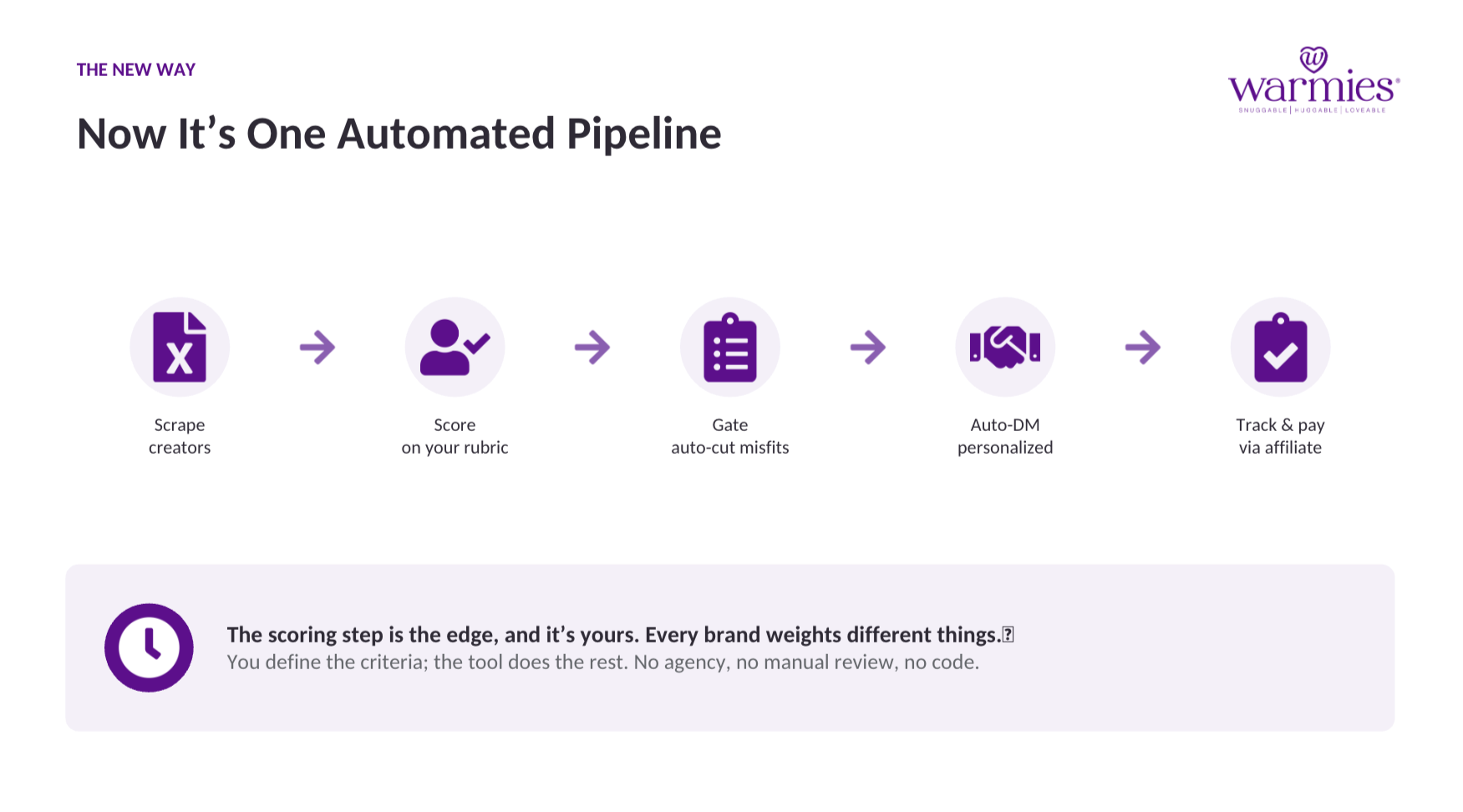
1. The pipeline starts with creator data
Warmies started by scraping creator profiles directly from TikTok. Every profile became a potential creator that could be evaluated against their scoring criteria.
The scraped data included information such as:
- Bio text
- Audience size
- Engagement metrics
- Creator content
- Video captions
2. Every creator is scored against Warmies' rubric
Each creator is automatically evaluated using Warmies' weighted scoring rubric. Positive and negative characteristics contributed to an overall score, allowing the team to apply the same qualification criteria across thousands of creator profiles.
Here's an example of Warmies' scoring logic:
Creators who meet the minimum threshold progress through the workflow, while poor-fit candidates were filtered out automatically.
3. Low-scoring creators never reached the team
Once every creator receives a score, the system automatically filters out poor-fit candidates. For Warmies, creators scoring below 70 out of 100 are removed before anyone reviews their profile.
The scoring system was similar to an initial screening interview. Instead of manually reviewing thousands of creators, the team only evaluated creators who had already passed the brand's qualification criteria.
4. Outreach was personalized using creator data
Warmies used the information gathered during scraping to generate personalized outreach messages for qualified creators.
Instead of sending generic pitches, making outreach more relevant without adding manual work.
5. Creator management became part of the same workflow
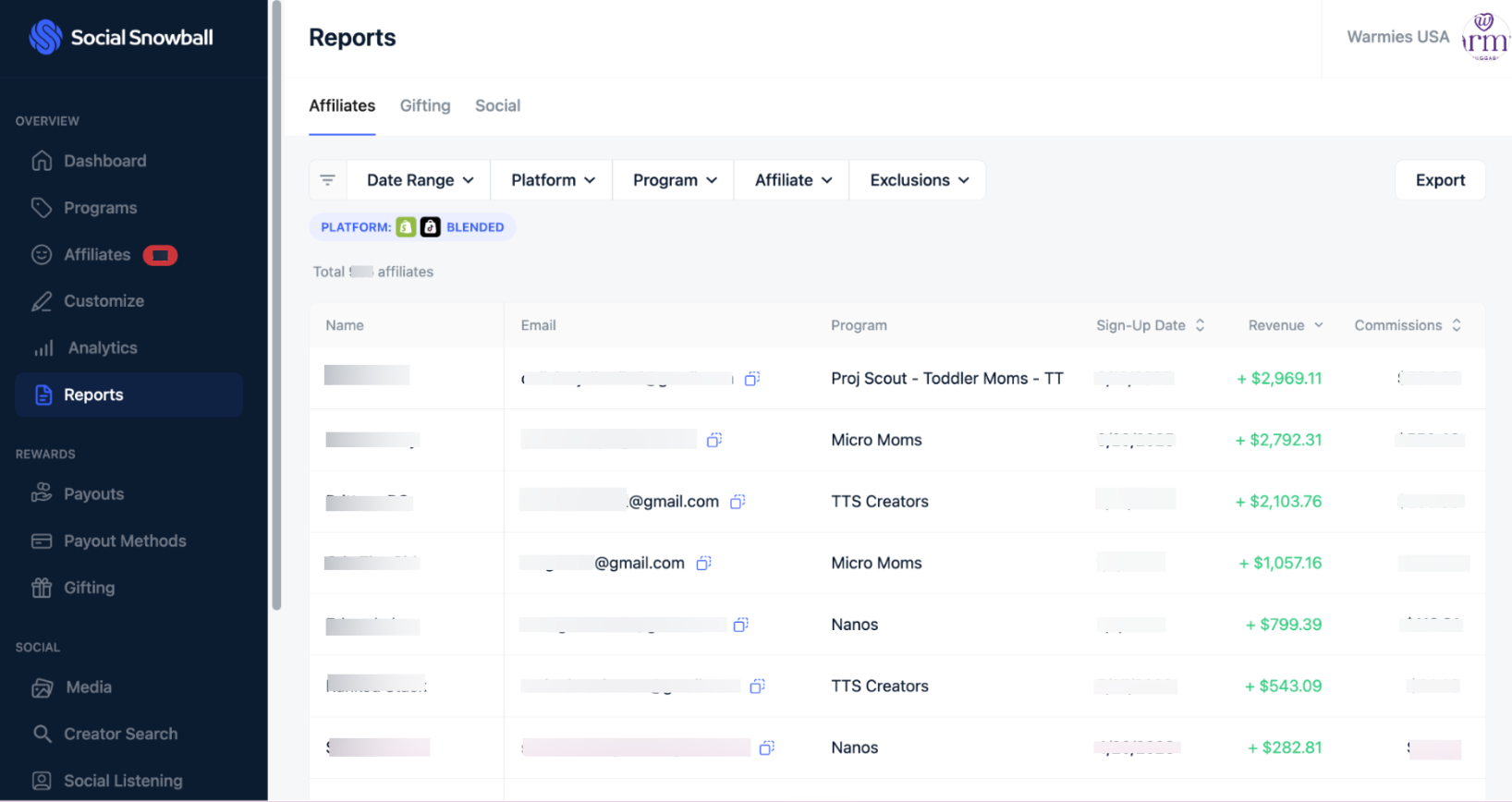
Once creators join the program, the operational work moves into Social Snowball.
Christian’s team uses the platform to onboard affiliates, manage product sampling, track performance, and process payouts, creating a seamless transition from creator discovery to long-term partnership management.
Warmies typically structured creator partnerships around:
- A flat fee
- A 15% affiliate commission
- One or two product samples
This combination of streamlined operations and performance-based compensation makes it easier for Warmies to scale their creator programs without adding administrative complexity.
Results achieved by Warmies
Christian shared the results from a two-month test:
- 10,000 creator profiles scraped over two months
- Cost per qualified creator reduced from $12 to $0.13
- ~90x lower sourcing costs per qualified creator

The tech stack behind the workflow
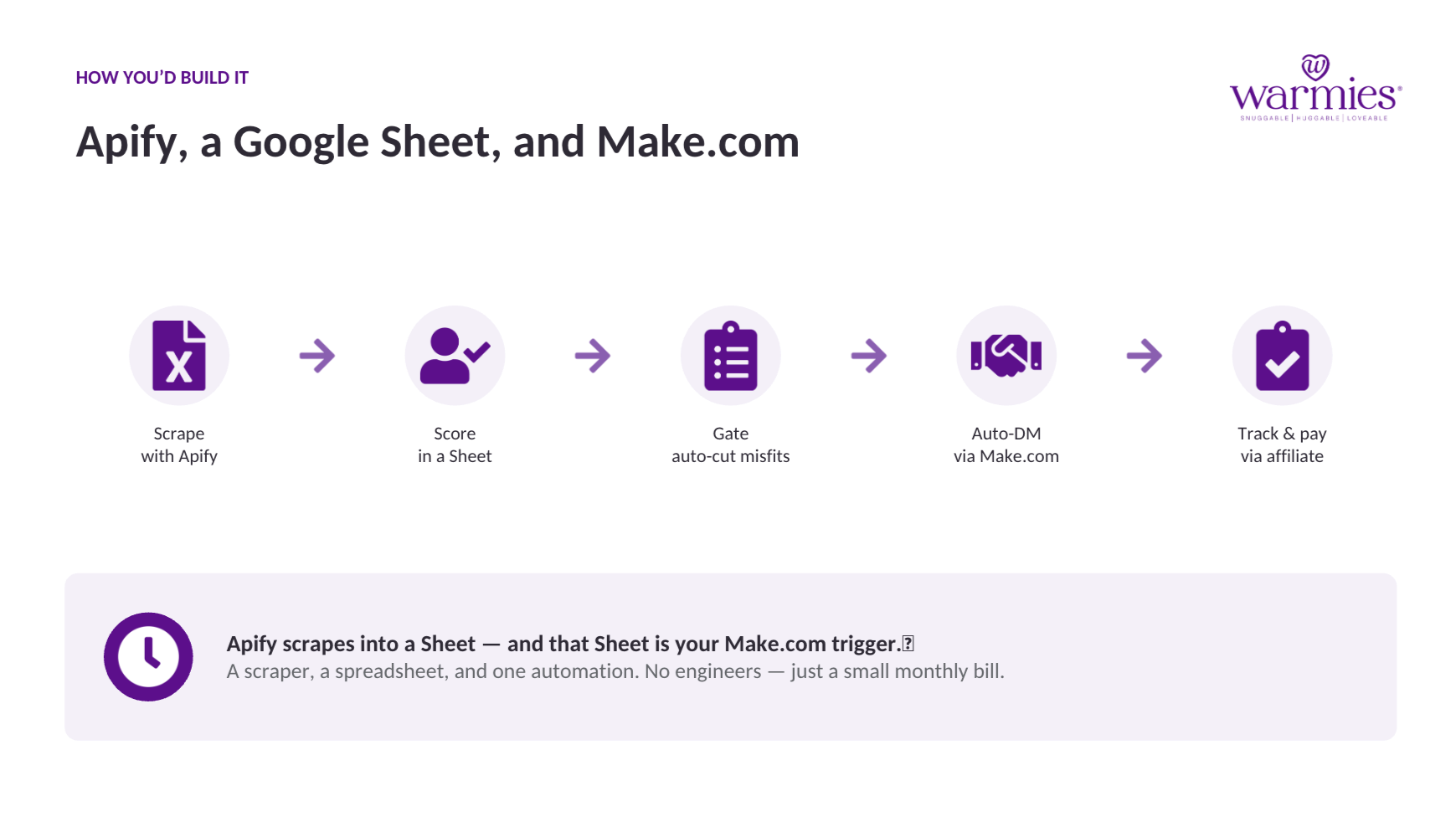
This system wasn't built with custom software. Instead, Warmies connected existing tools into a single automated workflow.
Christian described this as Warmies' "V1" creator sourcing workflow.
The team has since evolved it into a more advanced, agentic system. The tools may change, but the underlying approach remains the same:
- Build a scoring framework around your ideal creators
- Then automate the repetitive work, so your team can focus on building relationships with the right partners
Why better creator sourcing improves the economics of creator marketing
Building a better sourcing system doesn't just help you find more creators. It improves the economics of your entire creator program.
Christian's biggest takeaway was that the value of creator marketing compounds over time. The more efficiently you can identify and activate high-quality creators, the more content, partnerships, and revenue your program generates without increasing costs at the same rate.
Below are some reasons why better creator sourcing improves the economics of creator marketing.
Creator marketing scales more efficiently than paid advertising
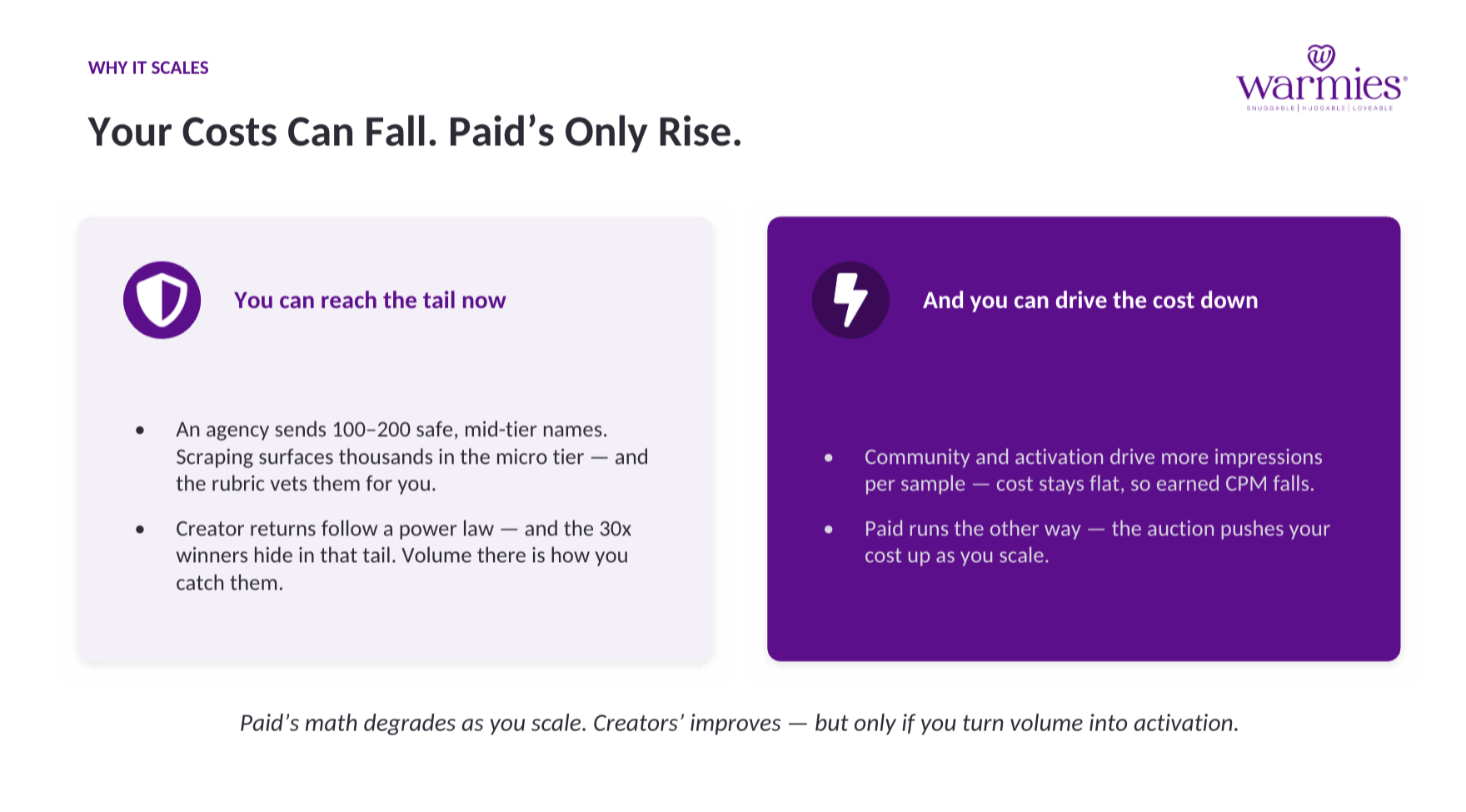
Most paid acquisition channels become more expensive as you scale them.
You're constantly competing in auctions, testing new creatives, and absorbing rising acquisition costs. As Christian put it:
"Our paid performance marketing costs only ever rise."
Creator marketing works differently.
Once you've built a repeatable sourcing system, adding more creators doesn't dramatically increase costs. You're primarily investing in product sampling and affiliate commissions while continually expanding your pool of creators and content.
"With creators, our costs are basically the sampling fee plus the affiliate commission, so we can actually bring down our CPM costs."
As your creator community grows, so does the amount of content it produces, making the program more economical for your brand over time.
Better sourcing helps you find more breakout creators
Not every creator delivers the same results.
Christian believes creator performance follows a power law, where a small percentage of creators become outsized winners.
"We follow the power law for creators. So only a small number of creators turn out to be 30x winners for us."
The more creators you can evaluate, the greater your chances of finding those exceptional partners.
By automating qualification, Warmies expanded its funnel from hundreds of creators to thousands, increasing the likelihood of discovering more high-performing partnerships without increasing costs and time spent on manual review.
Earned media becomes more efficient over time
Every creator you activate produces more than just attributed sales. They also create content that can be repurposed across paid media, organic social, and future campaigns.
As more creators join the program, your content library compounds while acquisition costs remain relatively stable.
Christian shared that Warmies currently ranks in the top 0.2% of TikTok Shops globally for GMV, views, and video – a sign of how a well-built creator program can compound as more creators and content are added over time.
Despite June and July being among the company's slowest seasonal months, Warmies drove 19 million social impressions in a single month, primarily through its creator program. Christian expects that figure to grow 6x to 8x heading into Q4.

The impact extends well beyond attributed revenue
Affiliate dashboards only capture part of creator marketing's value.
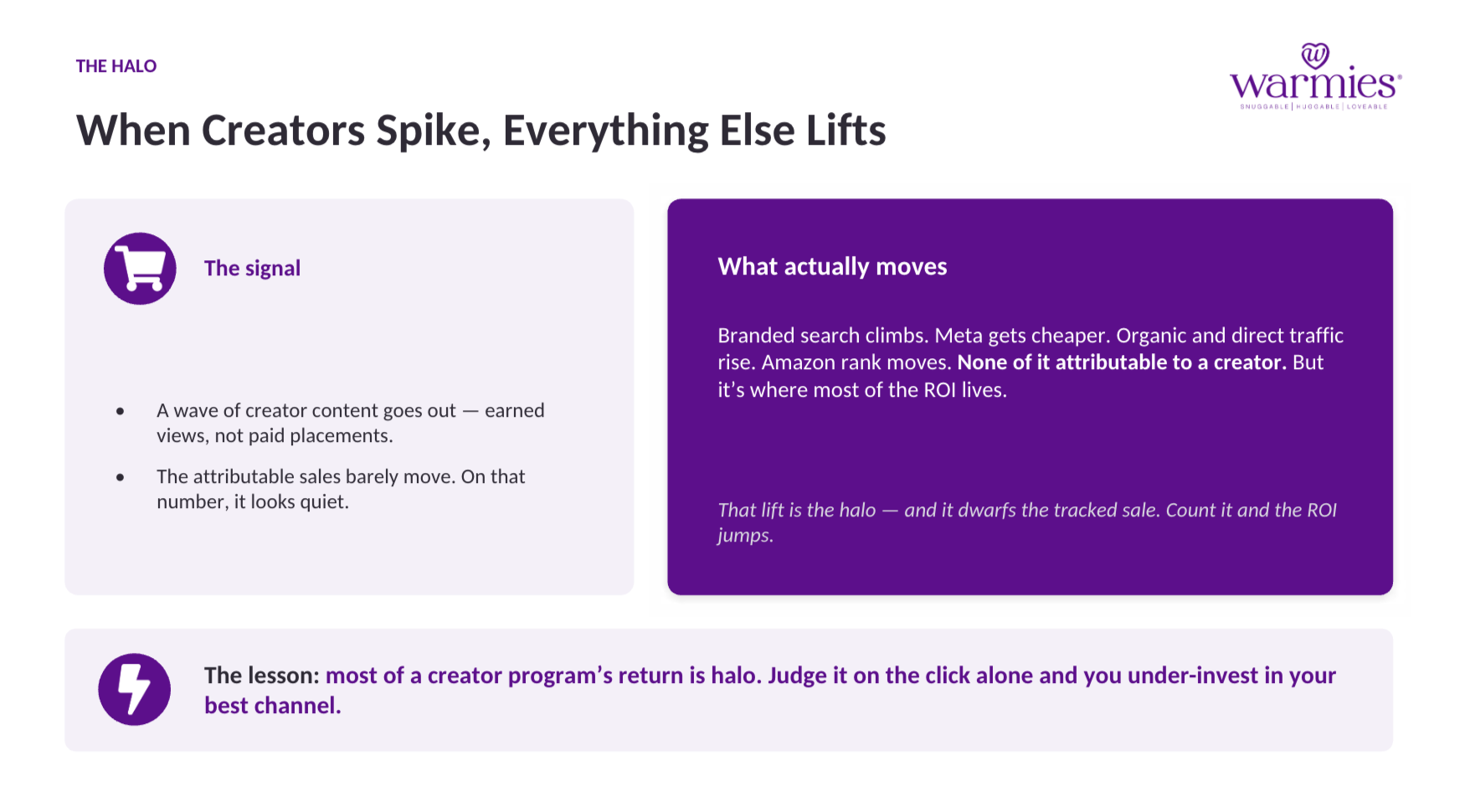
"Tracking GMV is great, but where we saw the real value was the halo effect."
As Christian’s team expanded Warmies’ creator program, they saw benefits across multiple channels:
- Branded search increased.
- Meta conversion rates improved by 27% year over year.
- Greater organic visibility and brand awareness.
- Stronger performance across creator marketplaces as product visibility increased.
Those outcomes rarely appear in affiliate reporting, but they reduce acquisition costs and improve marketing performance across the business.
That's why Christian cautions against evaluating creator marketing using affiliate-attributed revenue alone. The value extends well beyond the sales you can attribute to a single affiliate link.
How to build your own creator scoring system
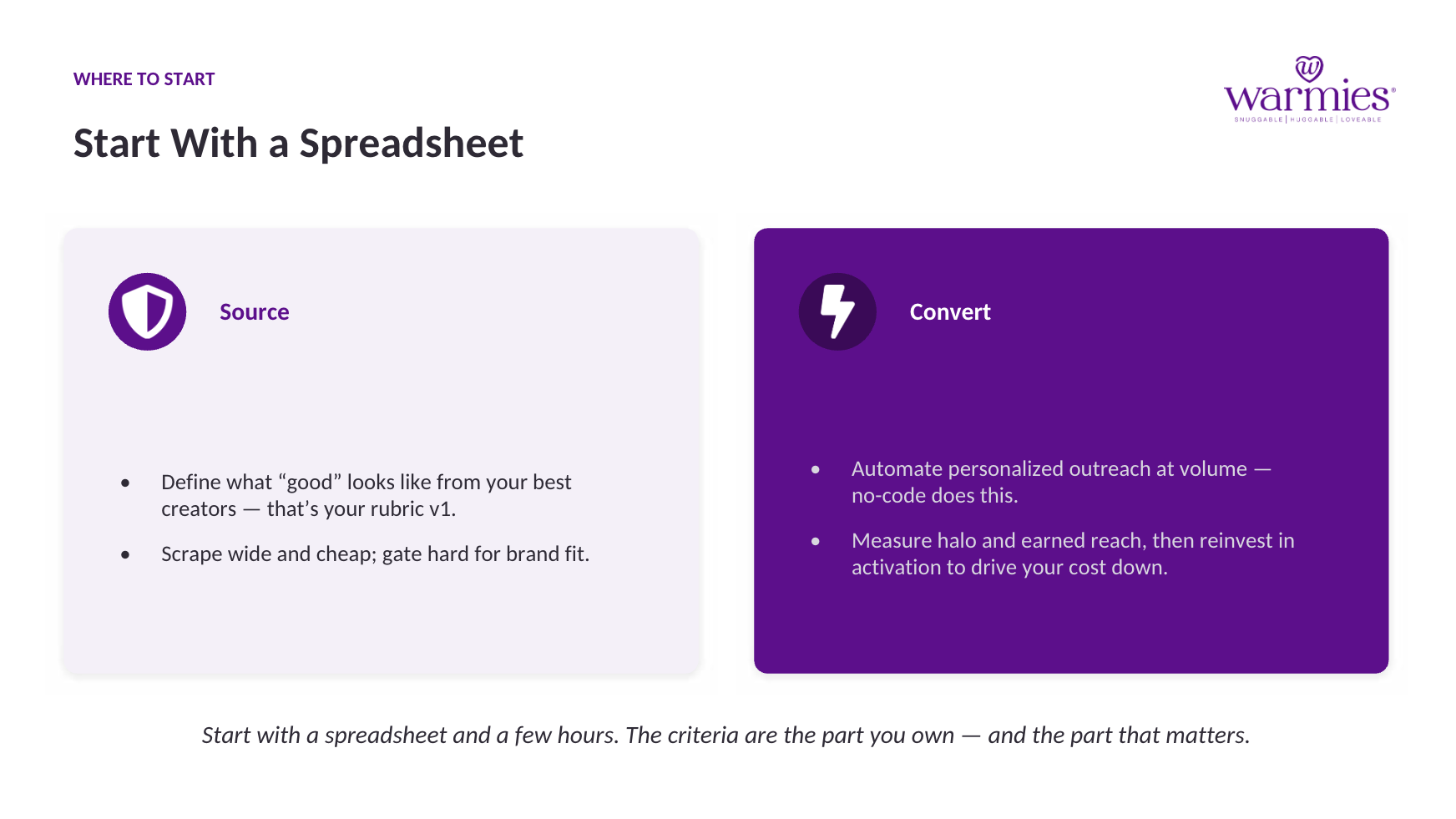
Christian's advice isn’t to build a complex AI system. It’s to create a repeatable process for identifying the right creators for your brand, then use AI to apply that process at scale.
Here's how to get started.
Step 1: Define your ideal creator
Start by looking at your best-performing creator partnerships. What do they have in common? Who is their audience? How big is their audience? What does engagement look like? What type of content do they produce? Those shared characteristics become the foundation of your scoring rubric.
Some signals to consider include:
- Audience size
- Engagement rate
- Niche
- Bio keywords
- Geographic location
- Content themes
- Creator demographics
Your rubric should reflect the kind of creators that drive revenue for your brand.

Step 2: Find creators
Once you've defined your ideal creator profile, expand your search.
Rather than manually browsing TikTok and Instagram, find creators using keywords and hashtags related to your category. Or use a creator discovery tool.
Capture information such as:
- Creator bio
- Follower count
- Engagement metrics
- Video captions
- Video content
Store every profile in a central database or spreadsheet so each creator can be evaluated consistently.
Step 3: Turn your rubric into a scoring model
Start by building your scoring rubric in a spreadsheet. List each qualification signal, assign it a positive or negative weight, and use the spreadsheet to calculate an overall score for every creator.
For example, Warmies assigns +40 points to creators with 1,000–10,000 followers because they fit the brand's ideal micro-influencer profile, while creators outside its target geography receive -90 points.
Once you've defined your weighting, establish a qualification threshold. Creators who don't meet that threshold can be filtered out before your team spends time reviewing them.
Step 4: Score and qualify creators with AI
Once your rubric is in place, use AI to apply it consistently across every creator profile.
Christian's workflow used OpenAI to evaluate both structured data, such as follower count and engagement, as well as qualitative signals, like bio information and creator content.
It’s important to note that AI isn't deciding what makes a good creator. It just evaluates creators against the criteria you've already defined, producing consistent scores across thousands of profiles.
Step 5: Automate personalized outreach
The same creator data used for scoring can also power personalised outreach.
Once they meet your qualification criteria, use the information from each creator's bio, niche, or content to tailor your outreach.
Tools like Make.com can trigger these outreach workflows automatically once creators qualify.
Step 6: Connect your affiliate platform
Once creators join your program, move them into your affiliate platform to manage onboarding, product sampling, commissions, performance tracking, and payouts.
Platforms like Social Snowball streamline creator management by automating onboarding, product seeding, payouts, fraud prevention, communication, and reporting, allowing your team to focus on building stronger creator partnerships.
Step 7: Refine your rubric over time
Your scoring model should improve as your creator program grows.
Compare creator scores against actual campaign performance and adjust your weighting as you learn which characteristics consistently predict successful partnerships.
Test and refine your rubric until your scoring system reliably identifies the creators your team would have selected manually.
"Create a weighting that's relevant to your business, and then test and test and test until you get to a point where you look at it and say, 'Yes, this is someone that we would work with if we selected them by hand.'"
Turn creator sourcing into a scalable system
You don't need expensive software to build a scalable creator sourcing system.
Start with a spreadsheet, define your ideal creator, build a scoring rubric, and use AI to apply it consistently at scale.
As your program grows, keep refining the rubric. The tools you use will change over time. You might swap spreadsheets for databases or replace one automation platform with another.
But the framework you build becomes a lasting competitive advantage for your brand.
Once you've built a reliable creator sourcing engine, the next step is managing those partnerships at scale.
Social Snowball helps you turn creator-led growth into your unfair advantage. Recruit creators, run gifting campaigns, turn customers into ambassadors, eliminate affiliate code leaks, track commissions, process payouts, and measure performance – all from one dashboard. By connecting creator sourcing with affiliate management, you can scale your program without adding operational complexity.

.avif)