
.png)
Most brands either set commissions too low for creators to care or too high to stay profitable. This problem usually comes from treating affiliate commission rates as a fixed number instead of a growth lever tied to customer acquisition costs (CAC), margins, and revenue.
Strong affiliate programs use commission structures to drive profitable creator behavior at scale. The payout model influences who joins your program, how consistently creators post, and whether affiliate acquisition stays efficient as volume increases.
This matters even more now because creator marketing runs as an always-on acquisition channel. Brands work with hundreds of affiliates simultaneously, track attributed revenue in real time, and invest more on creators who consistently convert.
This guide breaks down how affiliate commission rates work and which commission structures fit different growth stages.
How affiliate commission rates work
Affiliate commission rates determine how revenue gets shared between your brand and the creators driving sales. The structure directly influences creator motivation, customer acquisition costs, and how efficiently your affiliate program scales.
Most affiliate programs follow the same workflow:
- A creator receives a unique tracking link or discount code tied to their account.
- When a customer purchases through that link or code, the sale gets attributed back to the creator.
- The creator earns a percentage of the order value.
For example, a creator earning a 15% commission would make $15 on a $100 order.
This structure works well for ecommerce because payouts stay aligned with measurable revenue. As creators drive more sales, their payout increases. That alignment gives brands a clearer acquisition model and gives creators a direct financial reason to keep producing content that converts.
For brands managing dozens or hundreds of creators, commission-based payouts also create more flexibility than fixed sponsorship budgets. Spend expands alongside revenue instead of requiring large upfront commitments before performance data exists.
How attribution works
Affiliate commissions depend on attribution systems that connect each order to the right creator. Most ecommerce brands use one or more of these tracking methods:
- Affiliate links that track clicks and conversions
- Discount codes tied to individual creators
- Platform-native attribution through channels like TikTok Shop
Each method creates a direct connection between creator activity and revenue generated. That visibility becomes increasingly important as programs scale, and multiple creators promote the same products simultaneously.
For example, a TikTok creator might post a product review using a custom discount code, while another creator drives traffic through a storefront link in their Instagram bio. Attribution systems separate those conversions automatically, so payouts stay accurate.
When commissions get paid
Most brands pay out commissions after orders move past the return or refund window. This protects margins and keeps commissions tied to confirmed revenue instead of temporary purchases.
Payouts usually follow a fixed schedule, such as:
- Monthly payouts
- Bi-weekly payout cycles
- Net-30 commission structures
As affiliate programs grow, payout management becomes operationally heavier. Tracking creator performance, validating orders, managing tiered commissions, and sending bulk payouts across hundreds of affiliates can quickly become manual work.
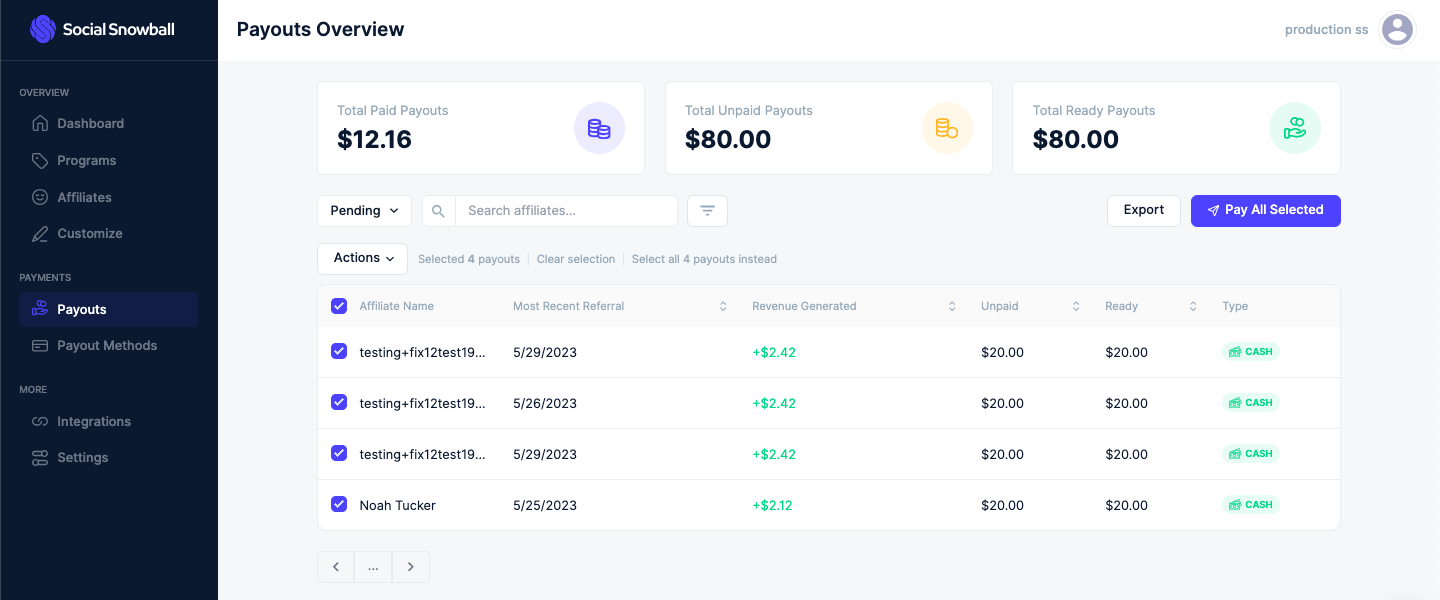
Platforms like Social Snowball automate these workflows by handling attribution, commission tracking, tiered payouts, discount codes, and creator performance management from a centralized dashboard.
Three variables that define your commission ceiling
The best affiliate commission rate starts with your unit economics. Before deciding what creators should earn, you need to understand how much your business can afford to spend on customer acquisition while staying profitable.
The following metrics shape that decision.
1. Contribution margin
Contribution margin tells you how much money remains from an order after covering the direct costs required to fulfill it.
Let’s say you sell a product for $100. The product price is $35, shipping and fulfillment is $10, and payment fees is $5. This means you get to keep roughly $50 before acquisition costs.
That remaining amount determines how aggressively you can pay creators while still keeping the order profitable.
Brands with higher margins usually have more flexibility when setting affiliate payouts. Categories like supplements and skincare can often support stronger commissions because repeat purchases and lower fulfillment costs create more room to acquire customers profitably.
Lower-margin categories like electronics usually need tighter commission controls to protect profitability as creator volume grows.
2. Customer acquisition cost (CAC) targets
Your target CAC determines how much you are comfortable spending to acquire a customer through affiliate marketing strategies. Most ecommerce teams already benchmark CAC across channels like Meta ads, Google Shopping, TikTok ads, and influencer campaigns.
Affiliate programs should be evaluated the same way. If paid ads acquire customers at $60 CAC and affiliates consistently acquire customers at a CAC of $35, there may be room to increase commissions and scale creator volume more aggressively.
Strong affiliate programs often become attractive because acquisition costs stay tied directly to attributed revenue instead of fluctuating daily with ad auctions.
3. Customer lifetime value (LTV)
LTV changes how aggressively you can invest in acquisition. Brands with strong repeat purchase behavior can usually afford higher upfront commissions because the first order is only part of the total customer value.
For example:
- A one-time purchase product may need tighter commission controls.
- A subscription brand with six-month retention can spend more aggressively to acquire customers upfront.
This is why categories like supplements, skincare, coffee, and consumables often support higher affiliate commission rates. Repeat purchases create more room to recover acquisition spend over time.
Common commission models (and when to use them)
The right commission structure depends on what you want creators to optimize for. Some models work best for predictable scaling, while others help drive short-term volume or strengthen relationships with top-performing creators.
Here’s how most ecommerce brands structure affiliate payouts.
Flat percentage (most common)
Flat percentage commissions are the most common structure in affiliate marketing programs. Creators earn the same percentage on every sale they drive. A typical setup might look like:
- 10% commission per sale
- 15% commission per sale
- 20% commission per sale
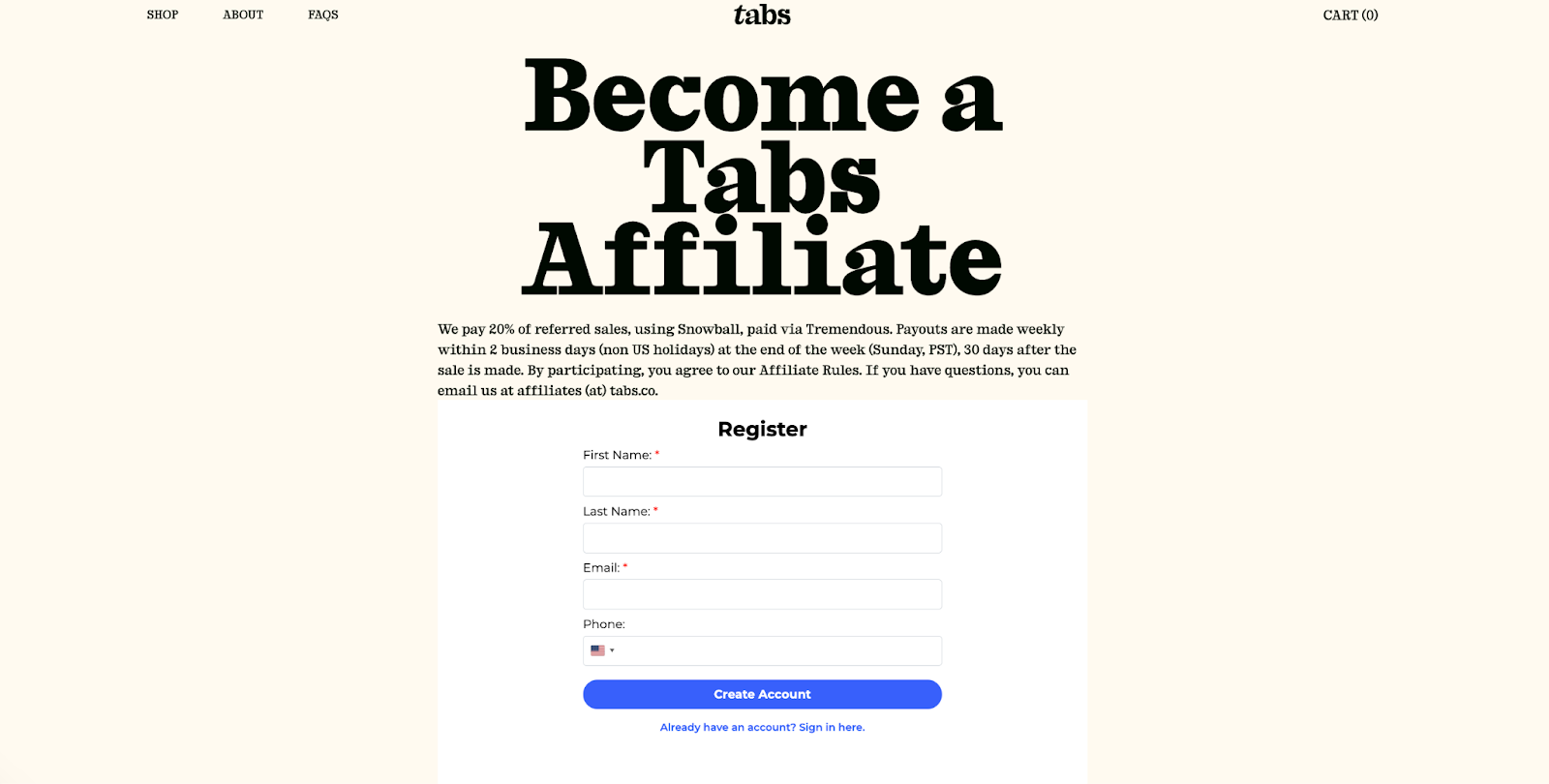
This model works well because creators immediately understand how payouts work, and brands can scale programs without constantly adjusting commission rules.
Flat percentage structures are usually the easiest to manage when onboarding many creators across affiliate programs, customer referral programs, or TikTok Shop campaigns.
Tiered commission
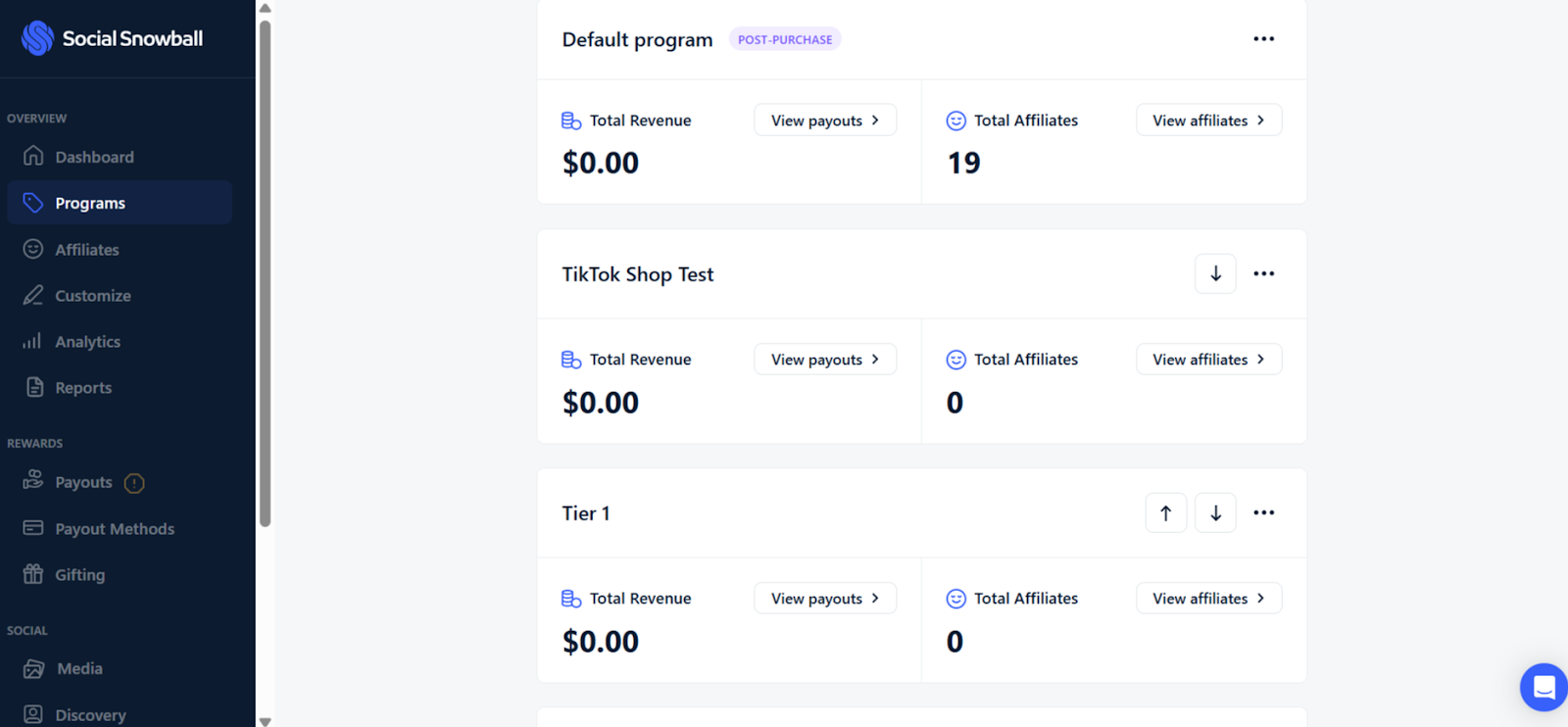
Tiered referral commissions reward creators for driving higher revenue volume over time. As creators hit predefined sales milestones, their payout percentage increases automatically.
A tiered structure could look like:
- 10% base commission
- 15% after $5,000 in attributed revenue
- 20% after $10,000 in attributed revenue

This model gives creators a clear incentive to keep posting consistently instead of treating affiliate promotion as a one-time campaign. Tiered structures also help brands quickly identify high-performing affiliates and concentrate payouts on creators already generating lower CACs.
As programs scale, brands can use Social Snowball to automate tier upgrades, commission tracking, and payout adjustments without requiring manual management across hundreds of creators.
Hybrid (flat fee + commission)
Hybrid structures combine guaranteed payments with performance incentives. This structure is common when brands want both guaranteed content output and performance-driven revenue.
For example, a brand might pay:
- A $300 flat fee for content production
- Plus 10–15% commission on sales generated
Hybrid deals work especially well with mid-tier creators, creators with proven conversion history, long-term ambassador relationships, and creators producing paid social ad content.
Performance bonuses
Performance bonuses reward creators for hitting specific milestones within a campaign or launch period. A few examples of performance bonuses include:
- $500 bonus after $20K in revenue
- Additional payouts for top-performing affiliates
- Launch-week incentives tied to GMV targets
- Bonus commissions during seasonal campaigns
These incentives help increase creator activity during product launches, holiday campaigns, inventory pushes, and TikTok Shop growth periods. Performance bonuses also create urgency around short-term campaigns without permanently increasing baseline commission rates.
Affiliate commission benchmarks (what brands actually pay)
Affiliate commission rates vary by industry because margins, repeat purchase behavior, and creator competition all affect how much a brand can pay profitably.
On average, affiliate commissions are around 10% to 15%. Here are the most common commission benchmarks across affiliate marketing programs:
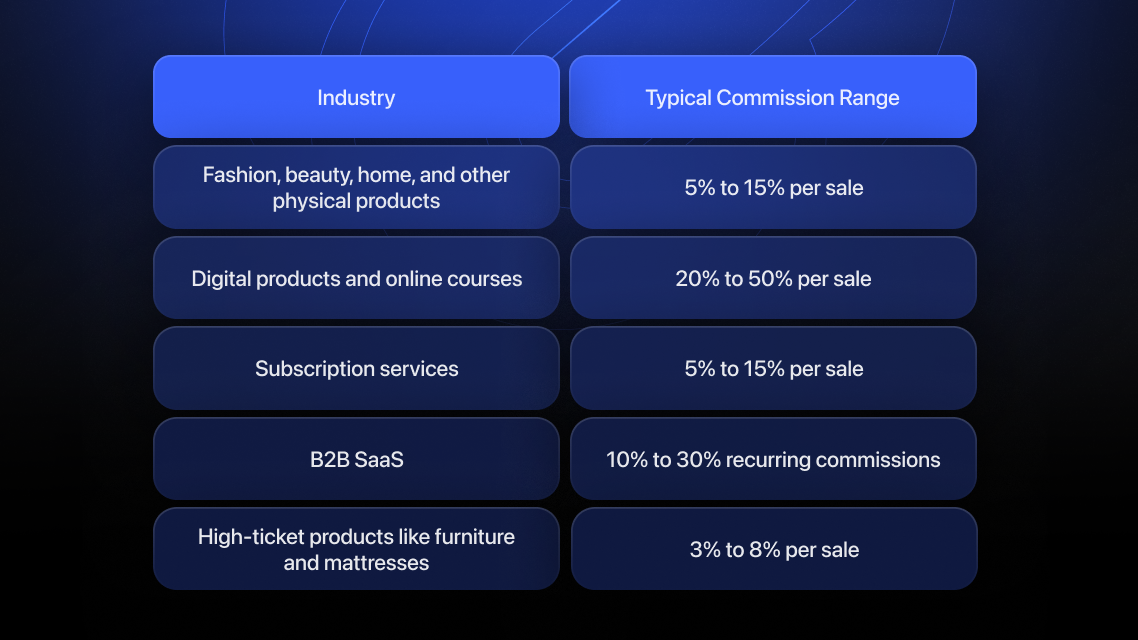
TikTok Shop benchmarks follow similar patterns. Beauty and skincare brands commonly offer 15% to 20% commissions because creator competition is high. Supplement brands often push closer to 20% to 25% since repeat purchases create stronger customer lifetime value.
Lower-margin categories like electronics usually stay between 5% and 12% because higher product prices leave less room for aggressive payouts.
These benchmarks give you a starting point, but your final commission structure should reflect profit margins, LTV, AOV, return rates, and how competitive your category is for creators and affiliates.
How to set the right commission rate (step-by-step)
The best affiliate commission rates balance creator motivation with profitable customer acquisition. If commissions are too low, strong content creators ignore the program. If payouts climb too high, margins tighten, and CAC becomes difficult to sustain as volume grows.
Use this framework to set commission rates that support long-term growth.
Step 1: Define your margin and CAC ceiling
Start with your unit economics before looking at competitor benchmarks. You need clarity on contribution margin, target customer acquisition cost, average order value (AOV), and customer lifetime value.
These numbers define how much flexibility your business has to pay creators profitably. For example, a subscription brand with strong repeat purchase behavior can usually support higher affiliate commission rates than a one-time purchase brand with tighter margins.
Step 2: Benchmark your category
Creators compare commission structures across affiliate programs constantly. Your payout needs to make sense within your category and platform ecosystem. Look at:
- Affiliate commission rates from competing brands
- TikTok Shop commission ranges
- Amazon affiliate payouts
- Commission structures across affiliate networks like ShareASale
Also, note that the product category is important here. Skincare, supplements, SaaS, and digital products often support higher commission rates because margins and LTV are stronger. Whereas, physical products with lower profit margins usually require tighter controls.
Step 3: Calculate your ideal commission range
At this stage, you already know what your business can afford and what creators expect within your category. Now you need to find the payout range where both sides stay incentivized.
Your commission rate should leave enough room to acquire customers profitably, absorb affiliate discounts and refunds, and still motivate creators to prioritize your product over competing partnerships.
For example, if your average order value is $80 and your target CAC is $30, offering a 25% commission immediately puts pressure on margins before you’ve accounted for discount codes, shipping subsidies, payment processing fees, repeat creator bonuses.
On the other hand, a low payout may reduce creator participation completely, especially in competitive categories where affiliates compare commission structures across multiple brands.
This is where commission modeling becomes important. Social Snowball’s Affiliate Commission Calculator helps you estimate a starting range using AOV, gross profit margins, customer lifetime value, repeat purchase rate, affiliate discounts, and CAC targets.
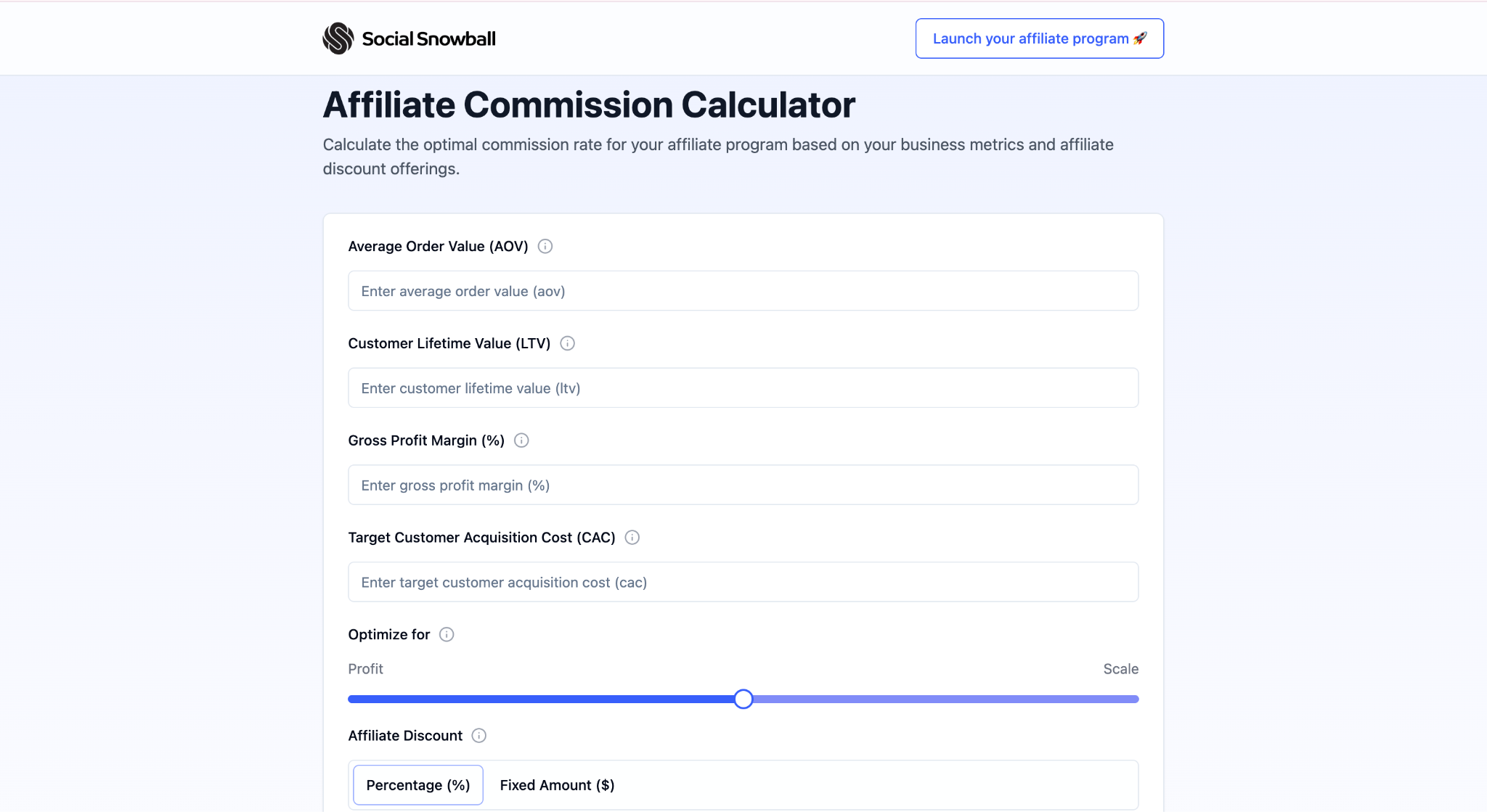
The calculator helps you pressure-test different payout scenarios before rolling them out across your affiliate program. For example:
- Brands with strong repeat purchase behavior can usually support higher upfront commissions.
- Low-margin products may need tighter commission controls and lower discount percentages to stay profitable as creator volume scales.
However, make sure to use the output as a working range, then refine it based on actual creator performance, conversion rates, and acquisition costs over time.
Step 4: Start slightly above average
Early-stage affiliate programs usually need stronger incentives to attract creator attention and generate testing volume.
Higher commission rates during the launch phase can help you:
- Recruit affiliates faster
- Increase creator participation
- Collect conversion data earlier
This matters most when you are building a new affiliate marketing program or expanding creator partnerships through TikTok Shop and social media affiliates.
Step 5: Test and observe behavior
Once creators start posting, evaluate performance beyond top-line revenue. Track metrics like conversion rates, affiliate CAC, repeat purchase behavior, AOV, and content output consistency.
A creator driving lower volume with stronger conversion quality may be more valuable than a large influencer generating high clicks but weak purchases.
Step 6: Adjust based on performance
Affiliate commission rates should adapt to performance.
You can increase payouts for:
- Top affiliates driving profitable revenue
- Creators generating recurring commissions
- Partnerships producing high-quality customers over time
You may also need to restructure payouts if margins tighten, conversion rates fall, or certain products cannot sustain high commission payouts profitably. As your program matures, commission structures should evolve with it. Tiered commissions, bonuses, and recurring incentives help retain successful affiliates while keeping acquisition costs predictable.
Aligning commission with different growth stages
The commission structure that helps early-stage brands test creators usually looks very different from the structure that supports mature affiliate programs at scale.
As your creator program grows, your commission model should evolve alongside your goals.
Early stage (no proven channel)
At this stage, most brands are still validating which creators convert, what content drives purchases, and whether affiliate marketing can become a reliable acquisition channel.
A hybrid structure usually works best here. Small flat fees help creators commit to initial content, while commission payouts offer performance visibility from the start.
The goal during this phase is not to scale. It’s learning. You want enough creator activity to identify:
- Which audiences respond
- Which content formats convert
- What CAC affiliate traffic can realistically support
For example, a skincare brand might send a free product as well as a small upfront payment to 20 creators, then use affiliate commissions to measure who actually drives revenue. After a few weeks, the brand can double down on the creators consistently generating profitable sales.
Scaling stage (proven conversion)
Once creators consistently drive profitable revenue, the bottleneck shifts from testing to volume.
This is where commission-heavy models start working far more efficiently. Instead of negotiating individual sponsorship deals constantly, brands can scale creator participation while keeping payouts tied directly to performance.
At this stage, most programs focus on 3 goals:
- Increase creator volume.
- Expand affiliate recruitment.
- Identify top performers faster.
Strong creators keep posting because higher sales increase their earnings. Lower-performing creators usually become inactive over time, which helps you scale without locking budgets into fixed payouts.
Many DTC brands also begin introducing tiered commissions to encourage higher output from creators driving high conversions
Mature stage (predictable revenue)
Once affiliate revenue becomes predictable, the focus shifts toward retention, efficiency, and deeper creator relationships.
Top-performing affiliates often become meaningful revenue channels on their own. Brands start protecting those relationships more aggressively through:
- Higher commission tiers
- Recurring bonuses
- Monthly retainers
- Exclusive launches
- Long-term ambassador partnerships
At this stage, the goal is usually to increase creator lifetime value, improve content quality, and stabilize revenue from proven affiliates. A mature affiliate program often ends up looking similar to a performance sales team, where incentives expand alongside contributions to revenue.
How to operationalize commission at scale
Affiliate programs become operationally complex once creator volume increases. Managing commissions across hundreds of creators requires systems that automate tracking, payouts, and reporting accurately without adding manual overhead.
Most scalable affiliate programs rely on four core workflows:
- Automated tracking: Affiliate links, discount codes, and TikTok Shop attribution connect every order to the right creator automatically.
- Tiered commission management: Performance-based rules adjust commission rates as creators hit revenue milestones or sales targets.
- Bulk payouts: Centralized payout systems help teams manage commissions, bonuses, and refund windows without relying on spreadsheets.
- Performance visibility: Unified reporting shows which creators drive profitable revenue, which content converts, and where acquisition costs stay efficient.
Platforms like Social Snowball help brands manage these workflows from one dashboard by automating attribution, commission structures, creator payouts, and affiliate reporting across Shopify and TikTok Shop.
Set the right commission rate to grow your affiliate program
The best affiliate commission rates align creator incentives with profitable revenue growth. Winning programs balance three aspects at the same time: attractive payouts for creators, sustainable acquisition costs for the brand, and enough flexibility to scale volume over time.
Start with your margins and CAC targets, benchmark your category, and adjust commission structures based on actual creator performance. As your program grows, increase payouts for top-performing affiliates because they consistently drive efficient revenue.
Managing this manually becomes difficult once the volume of creators increases across multiple campaigns and channels. Social Snowball helps brands operationalize affiliate programs by automating tiered commissions, tracking creator performance across Shopify and TikTok Shop, and scaling payouts without increasing operational overhead.


.avif)