
Creator marketing has never been more popular.
Brands are investing more in creator partnerships, the creator economy continues to expand, and marketers have access to more data than ever to measure performance.
Yet despite all of that progress, many creator partnerships still fail to deliver the results brands expect. Brands spend thousands on creator campaigns only to see low engagement, minimal sales, one-off partnerships that never convert into long-term advocates, or content that feels inauthentic to audiences.
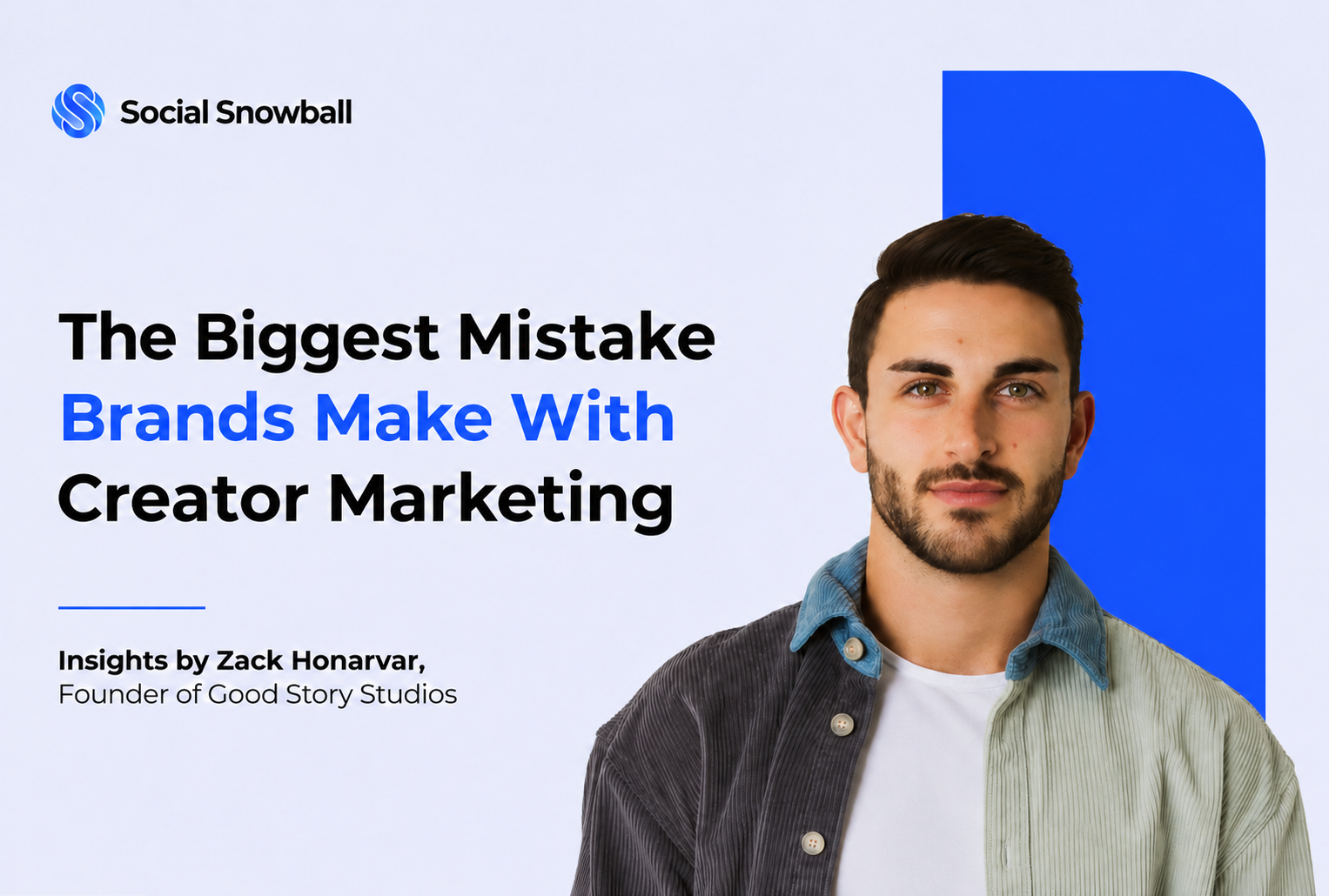
According to Zack Honarvar, Founder of Good Story Studios and former talent manager for some of YouTube’s biggest creators, the problem isn’t creator marketing itself. It’s how brands approach it.
In an episode of Word of Mouth, host Robyn Nissim sat down with Honarvar to discuss why so many creator partnerships are set up for failure, how brands can build stronger relationships with creators, and why the future of creator marketing looks more like storytelling than advertising.
Honarvar has spent years operating at the intersection of brands and creators, helping companies partner with some of YouTube’s biggest names while building campaigns that blur the line between entertainment and marketing.
Here’s what he had to say.
1. Why did you launch Good Story Studios?
When I looked at the creator economy, it felt like everyone was trying to force YouTube creators into one of two buckets.
On one side, creators were being treated like influencers whose primary job was to drive affiliate sales and performance metrics. On the other, they were being treated like media inventory, where brands simply bought impressions the same way they would buy television or programmatic advertising.
I felt like there was a gap between those two approaches.
That’s ultimately why we launched Good Story Studios.
We don’t sell media, and we don’t sell influencers. We sell shows.
The creators we work with are filmmakers, storytellers, directors, and talent. Instead of asking brands to interrupt a video with a 60-second ad, we’re helping them become part of the story itself.
A creator might come to us with an idea for a six-episode series. Traditionally, that idea would be pitched to a streaming platform or production company. Instead, we’re taking those ideas directly to brands and asking how they can be integrated into the story in a meaningful way.
The goal is to create partnerships that feel additive rather than disruptive. When it works well, the brand isn’t interrupting the content. It’s helping make the content possible.
2. What’s the biggest mistake brands make with creator marketing?
I think the biggest mistake brands make is treating creator partnerships like transactions instead of relationships.
Most creator partnerships are structured as one-off campaigns. Brands assume they’re going to work with a creator once, measure the results, and then decide whether creator marketing works.
Creators know this.
As a result, they’re conditioned to believe they’re only getting one opportunity with that brand.
I often compare it to dating. If you assume you’re never getting a second date, you’re probably going to optimize for the short term. You’re going to try to get as much value as possible from that one interaction because you don’t expect another opportunity.
That’s exactly what happens in creator marketing.
Creators often feel pressure to maximize the value of a single deal because they don’t believe a long-term relationship is on the table. Brands, meanwhile, are evaluating the partnership through a short-term lens and expecting immediate results.
Both sides end up optimizing for the wrong things.
The partnerships that work best are the ones where both parties view the relationship as something longer-term. When creators know they’re working toward a year-long partnership instead of a single campaign, the dynamic changes completely.
They’re more invested in the brand’s success. The brand gets more authentic integration over time. And both sides have the opportunity to build trust with the audience gradually rather than trying to force results from a single piece of content.
3. Why do brands struggle to measure creator marketing effectively?
A lot of brands are still measuring creator marketing the same way they measure paid advertising.
The mindset is often: “I spent $100,000 on this campaign, so I need to see at least $101,000 in revenue immediately, or it didn’t work.”
I think that’s the wrong way to think about creator partnerships.
The reality is that attention and consumer behavior have changed dramatically.
We’re living in one of the most saturated media environments ever. People are exposed to thousands of messages every day. It takes repeated exposure before a brand even enters someone’s consideration set.
Creator marketing isn’t always about driving an immediate purchase. Sometimes it’s about introducing a brand to a new audience. Sometimes it’s about building familiarity. Sometimes it’s about helping a brand become part of a cultural conversation.
Those things matter, even if they don’t show up instantly in an attribution dashboard.
Measurement still matters. Brands should absolutely understand where their dollars are going. But I think we need to evaluate creator partnerships on a longer time horizon.
The question shouldn’t always be whether a campaign generated immediate revenue. It should also be whether it helped move the brand closer to its broader business goals.
4. Why should creators be involved earlier in the process?
One of the most common mistakes I see is brands bringing creators into the process far too late.
A brand will spend months building a brief. The brief gets reviewed internally, passed through agencies, approved by stakeholders, and refined over and over again.
Then, after six months of work, they finally bring it to a creator.
The problem is that the creator had no input during any of that process.
If the creator suggests a different approach, the response is often, “No, we can’t change that because it’s already been approved.”
At that point, you’re no longer collaborating. You’re asking a creator to execute someone else’s idea.
The strongest partnerships happen when creators are involved earlier.
Creators understand their audience better than anyone else. They know what will resonate. They know how their content works. They know how to tell stories in a way that feels natural to their viewers.
If you want creator marketing to work, creators need a seat at the table before the strategy is finalized, not after.
5. What separates great creator partnerships from average ones?
Trust.
The best partnerships are collaborative from the beginning.
One of my favorite examples is a campaign we worked on with Pizza Hut and creator Eric Decker, better known as Airrack.
We had an idea to break the Guinness World Record for the world’s largest pizza. At the same time, Pizza Hut was bringing back the Big New Yorker pizza and looking for ways to generate excitement around the launch.
The timing aligned perfectly.
What made that partnership successful wasn’t just the idea itself. It was the willingness of everyone involved to build the concept together.
The brand trusted the creator.
The creator understood the brand’s goals.
Everyone was focused on telling a story people would actually care about.
The result was a campaign that generated earned media, industry recognition, and eventually footage that appeared in Pizza Hut’s Super Bowl commercial.
Those outcomes don’t happen because someone followed a rigid brief. They happen because people trusted each other enough to create something worth talking about.
6. Does creativity still matter more than budget?
Absolutely.
One of the biggest lessons I learned during my time at Shopify is that marketing isn’t about who can outspend who.
It’s about creativity.
You’re only as good as your idea.
Working with ecommerce brands showed me that smaller companies can compete with much larger organizations when they understand how to capture attention.
That’s even more true today.
The barriers to distribution are lower than they’ve ever been. Platforms are constantly rewarding good ideas regardless of company size.
A small brand with a compelling story can compete with companies that have significantly larger budgets.
That’s encouraging because it means success isn’t reserved for the biggest players.
It’s available to people who are willing to think differently.
7. What advice would you give marketers trying to build creator programs?
Give people room to experiment.
One of the reasons I ended up where I am today is because someone gave me an opportunity early in my career.
When I was at Shopify, I convinced the company to let me attend a trade show in Las Vegas. At the time, it was a relatively small bet for the company, but it completely changed the trajectory of my career.
That single opportunity led to relationships, partnerships, and experiences that opened doors I never would have found otherwise.
I think more companies need to create those opportunities internally.
If you have a young marketer who believes in creator partnerships, give them a small budget and clear success metrics. Let them build something. Let them test ideas. Let them prove what’s possible.
You don’t need to bet the entire marketing budget.
Sometimes all it takes is giving someone enough room to demonstrate what they can do.
The best ideas don’t always come from the most senior person in the room.
8. What do you hope people remember you for?
Professionally, I hope I’ve helped people become better operators, better entrepreneurs, and better business builders.
But honestly, when I think about how I want to be remembered, my answer has very little to do with business.
I’d rather be remembered as a good husband, a good father, and a good friend.
At the end of the day, business is important. Building companies is fulfilling. Creating things is meaningful.
But those relationships are what matter most.
If people remember me for showing up well in those areas of my life, I’d be pretty happy with that.
Key takeaways for brands to run creator marketing right
Throughout the conversation, Zack kept returning to one central idea: creator partnerships perform best when they’re treated like relationships, not transactions.
Here are the biggest lessons brands can take away:
- Treat creator partnerships as long-term relationships, not one-off campaigns.
- Involve creators early in campaign planning instead of handing them a finished brief.
- Measure creator marketing against campaign goals, not just immediate revenue.
- Build campaigns around stories that naturally feature the brand.
- Give creators clear direction, but trust them to communicate in their own voice.
- Prioritize strong creative ideas over bigger marketing budgets.
- Turn top-performing creators into long-term ambassadors.
- Test creator programs with small pilots, measure results, and scale what works.
The power of long-term advocacy
Whether you're building a creator program, affiliate network, ambassador community, or customer referral program, the same principle applies: people advocate for brands they trust.
The strongest advocacy programs aren't built around one-off transactions. They're built around long-term relationships, aligned incentives, and giving people a reason to keep talking about your brand.
That's also why the most successful programs compound over time. As trust grows, creators become advocates, advocates become partners, and every relationship creates more opportunities for authentic word of mouth.
Social Snowball helps ecommerce brands build those systems. From affiliate and creator management to automated payouts, referral programs, and performance tracking, it gives brands the infrastructure to scale advocacy without adding operational complexity.
Ready to build a creator and affiliate program designed for long-term growth?